
Beyond Electric Meters: Why IECC 2021 Requires Whole-Building Energy Monitoring
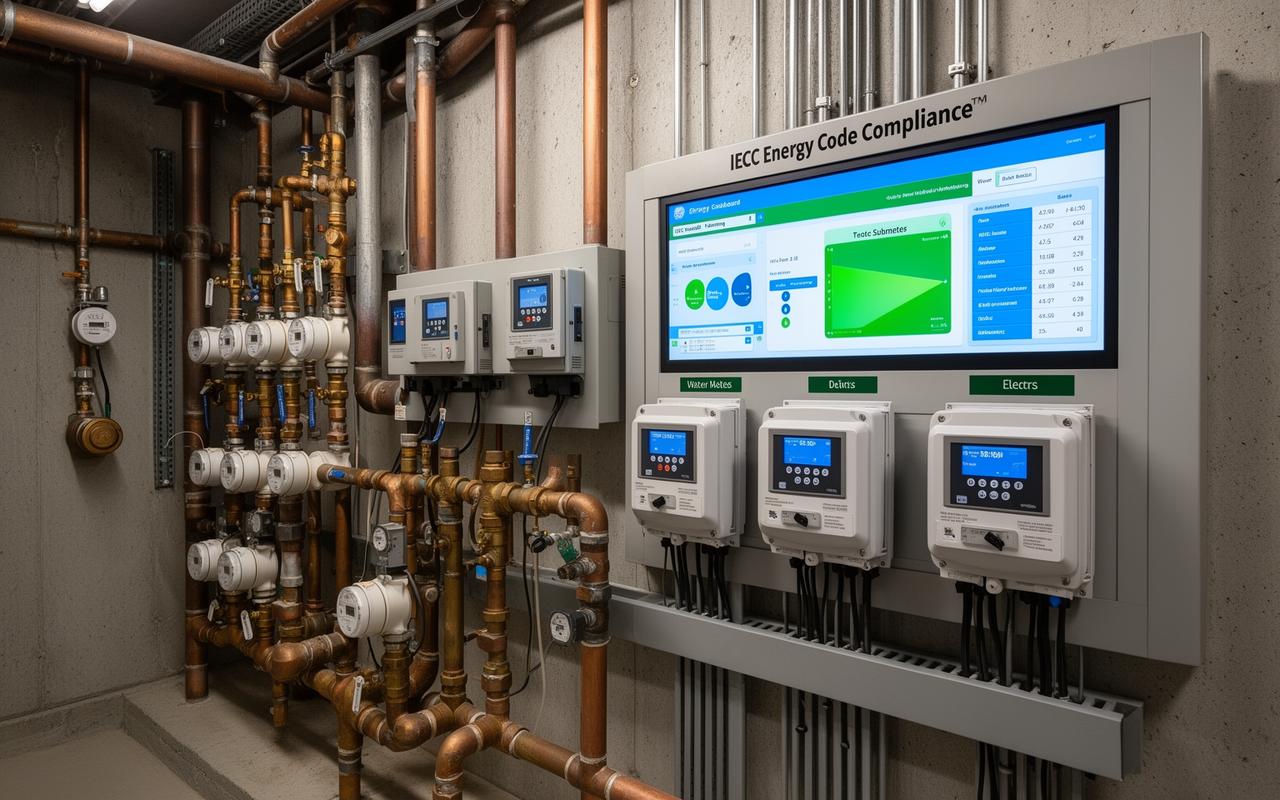
For decades, commercial buildings tracked energy with one main tool: the utility electric meter. The IECC 2021 changed this. This code now requires whole-building energy monitoring. This goes much further than simple electric metering.
The Old Way and Its Limits
Old energy monitoring used utility meters. These meters track electricity, gas, and water for billing. But they have big limits for managing energy.
What are the limits of utility meters for energy monitoring?
- Limited detail: Utility meters usually give monthly data. Electricity might get 15-minute data. Gas and water often only show monthly use. This makes it hard to see quick changes or link energy use to building operations.
- One point of measure: A utility meter only measures total use. It cannot show energy used by HVAC, lights, or other equipment. When energy spikes, managers don't know why.
- No fuel mix view: Many buildings use different energy types. This can include electricity, gas, steam, or chilled water. Utility meters only watch one fuel. It's impossible to see total building energy without gathering data from all sources.
- Slow feedback: Monthly bills arrive weeks after use. By the time a problem is seen, energy might have been wasted for a month or more.
What The IECC 2021 Requires
Section C405.12 of the IECC 2021 sets rules for whole-building energy monitoring. These are the main points:
What does IECC 2021 whole-building energy monitoring require?
- Monitor all energy types: Buildings must watch all energy coming in. This includes electricity, natural gas, fuel oil, and district energy sources. This is a big change from just tracking electricity.
- Record data: Monitoring systems must record energy use. Data must be saved at least every hour. This gives enough detail to find patterns and save energy.
- Access data: Building operators must be able to reach this data. The data often needs to be sent to tools like ENERGY STAR Portfolio Manager.
- Monitor systems: The code wants to monitor whole buildings. But it also needs separate monitoring for some systems. This is especially true for large HVAC systems.
Why Whole-Building Monitoring Is Important
The move to whole-building energy monitoring shows changes in how buildings manage energy.
Why is whole-building energy monitoring important?
Carbon Accounting
Cities and states now set carbon limits. Building owners need to know their total energy footprint. Gas and steam add a lot to carbon output. These are often targets for reducing emissions.
A building tracking only electricity might look good. Yet, its gas boiler could be very wasteful. Whole-building energy monitoring makes all energy sources visible. It holds them accountable.
Operational Optimization
Studies show buildings use 15-30% more energy than planned. This is often due to bad operations. Equipment running when not needed, wrong settings, or heating and cooling at the same time cause waste. Finding these problems needs constant data from all building systems.
Whole-building monitoring allows for "continuous commissioning." This is checking and improving building performance all the time. Studies show this can cut energy use by 10-20% for a low cost.
Benchmarking and Disclosure
Many places now require energy benchmarking for buildings. Most use ENERGY STAR Portfolio Manager. This needs data from all energy sources to get a score. Buildings tracking only electricity cannot join these programs well.
Many places are making benchmarking mandatory. They also require public showing of building performance. Whole-building energy monitoring gives owners the data they need to follow rules. It also helps them find ways to improve.
Financial Performance
Energy costs are a big expense for buildings. They often cost $2-4 per square foot each year. A 100,000-square-foot office might spend $200,000-$400,000 yearly. Even small energy savings can lead to big money savings.
You cannot improve what you don't measure. Whole-building monitoring provides the data. This helps find savings, confirm efficiency gains, and track costs.
How to Implement Whole-Building Monitoring
For buildings meeting IECC 2021, here are key steps for setting up whole-building energy monitoring.
Key considerations for whole-building energy monitoring implementation:
Meter Selection
Different energy needs different meters. Electricity uses current transformers (CTs) and power meters. Natural gas needs meters with pulse outputs. Steam metering is more complex, using various flow meters plus temperature and pressure sensors.
Choose meters that are accurate and communicate well. They should be accurate within ±2% for electricity and ±5% for thermal energy.
Data Infrastructure
Monitoring is only as good as its data system. A whole-building system needs:
- Data collection hardware (meters, sensors)
- Data communication (wired or wireless)
- Data storage (cloud or on-site)
- Data viewing and analysis tools
Modern energy platforms can combine data from many meter types. They offer one view of building energy. Many also find problems and create reports automatically.
Integration with Building Systems
The best monitoring systems link with building automation systems (BAS). This allows energy data to be compared with other data. Examples include occupancy and equipment status. This helps in deeper analysis and better energy use.
Commissioning and Verification
After installing, monitoring systems need checking. This ensures meters read right and data stores correctly. Ongoing checks should be part of maintenance.
The Future of Energy Monitoring
IECC 2021's rules for whole-building energy monitoring are just the start. The 2024 IECC has already expanded these rules. Future codes will likely demand more.
Buildings that adopt whole-building monitoring now will meet current codes. They will also be ready for future rules. This helps optimize operations, cut carbon, and improve finances. The cost of monitoring pays off many times in savings and avoiding fines.
Emergent Metering offers full whole-building monitoring solutions. We meet IECC 2021 and future needs. From meter choice to data platform and ongoing support, we help buildings get actionable insights and real results.
Beyond Whole-Building: Why More Detail Matters
The 2021 IECC rules are a baseline. Code experts know whole-building data is helpful. But it only shows part of the picture.
Why go beyond whole-building energy monitoring?
True value comes when monitoring extends to systems and circuits. A whole-building meter might show total power use. But it won't tell you if one rooftop unit uses 40% more energy. Or if lobby lights stay on all night.
Circuit-level monitoring, like Panoramic Power, goes further. Wireless, self-powered sensors give 10-second data on each circuit. This creates a full energy profile for each piece of equipment. This detail helps with scheduling, maintenance, and demand charges. It keeps buildings efficient year after year.
For buildings choosing a monitoring plan, IECC 2021 is a starting point. The code sets the minimum. High-level operation needs more. Circuit-level monitoring often brings 3 to 5 times more return on investment. This is because it provides richer, more actionable insights.
Building energy codes are advancing. Each new code wants more detailed monitoring. It wants more accessible data and better analysis. Buildings investing in full monitoring today will meet tomorrow's codes. They will also have years of data and proven savings. In energy management, seeing the data leads to every improvement.
Related Articles
Green Building United 2026 Sustainability Symposium: What to Expect After a Landmark 2025 Event
Mar 14, 2026 · 8 min read read
Energy Code Compliance Is Coming for Your Building — Are You Ready?
Mar 10, 2026 · 8 min read read
LCFS EV Charging Credits in 2026: How Metering Unlocks Maximum Credit Revenue
Mar 5, 2026 · 10 min read
About Emergent Metering Solutions
Emergent Metering Solutions provides commercial and industrial metering hardware, installation support, and energy analytics services. We specialize in electric meters, water meters, BTU meters, compressed air meters, gas meters, and steam meters with Modbus RTU, BACnet IP, pulse output, and wireless communication options. Our Managed Intelligence services deliver automated reporting, anomaly detection, tenant billing, and AI-powered consumption forecasting. We support compliance with IECC 2021, ASHRAE 90.1-2022, NYC Local Law 97, Boston BERDO 2.0, DC BEPS, California LCFS, and EU CSRD requirements.
Contact our engineering team for meter selection guidance, system design, and project quotes.