
The IECC 2021 Submetering Mandate: A Complete Guide to Subcircuit Monitoring for Commercial Buildings
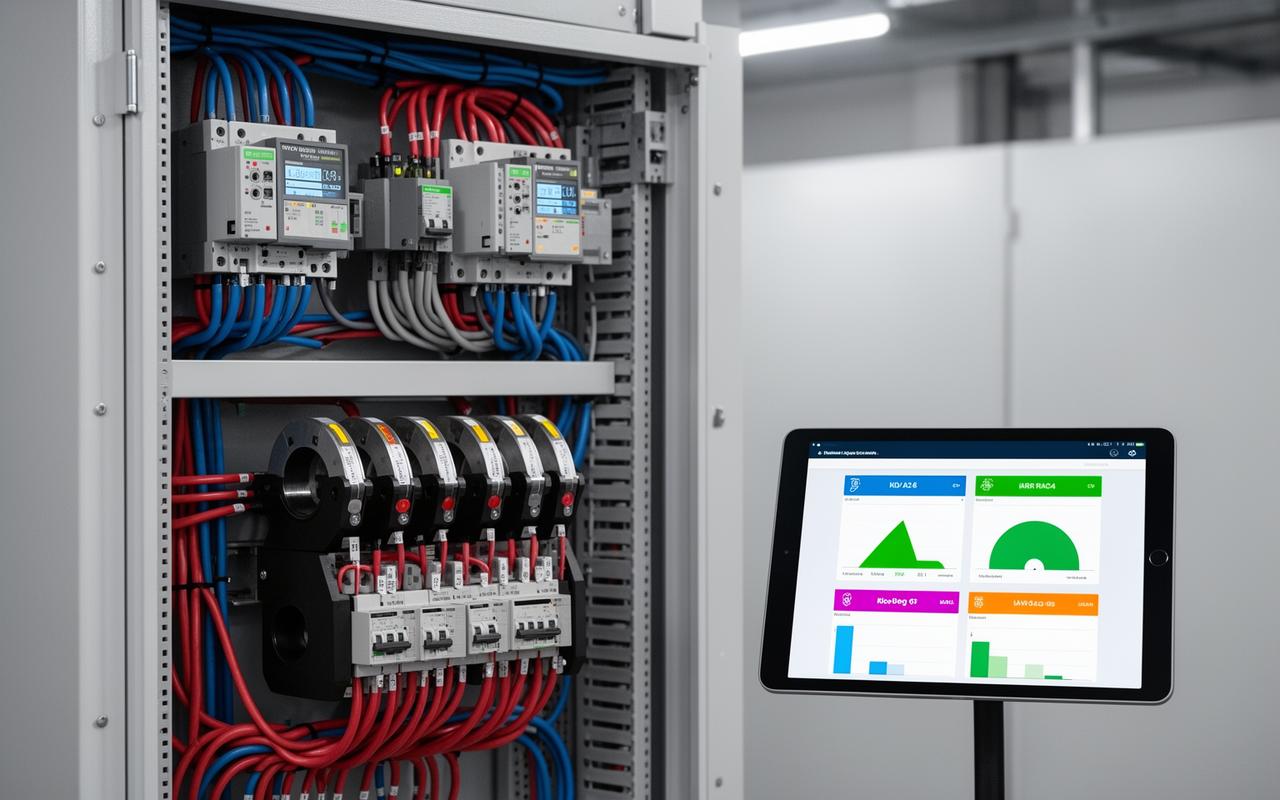
The [International Energy Conservation Code (IECC) 2021 now requires extensive subcircuit-level monitoring in commercial buildings. This guide explains the IECC 2021 submetering mandate. It provides key details for building owners, engineers, and code officials. This helps them achieve compliance.
Understanding the IECC 2021 Submetering Mandate
Section C405.12 of the IECC 2021 sets rules for energy metering. It mandates monitoring in commercial buildings. Previous codes had basic metering. The 2021 edition greatly expands these requirements.
The mandate covers new commercial buildings. It also applies to major renovations. This is for areas adopting the 2021 IECC. Most U.S. states have adopted the 2021 IECC or a later version. This makes these rules important for most new commercial construction.
Key Requirements of the IECC 2021 Submetering Mandate
The submetering mandate has specific rules:
- Whole-building metering: Each energy type entering the building needs a meter. This includes electricity, natural gas, and district heating/cooling.
- Electrical submetering: Buildings with over 250 kVA electrical service must meter specific uses.
- HVAC systems (heating, cooling, fans, pumps)
- Interior lighting
- Exterior lighting
- Receptacle circuits and plug loads
- Other large electrical loads over 50 kW
- Data recording: Meters must record data hourly or more often. They must store data for at least 36 months. This provides historical data for analysis.
- Data accessibility: Metered data must be available. It should be through a building automation system (BAS) or energy management system. This allows viewing, analysis, and export.
Why is Subcircuit Monitoring Important?
Subcircuit monitoring changes how we manage building energy. Old methods used whole-building data. This helped assess overall performance. But it gave little insight into specific problems.
Subcircuit monitoring offers clear visibility. It shows individual end-use categories. If energy use suddenly rises, this data shows which system is at fault. Is HVAC running too long? Has lighting use increased? Are plug loads higher?
This detailed view makes energy management proactive. It shifts from reacting to high bills to continuous system optimization.
The Research Basis for Submetering
Research supports the submetering mandate. It shows the value of detailed energy data:
- Lawrence Berkeley National Laboratory studies show savings. Buildings with submetering save 10-20% energy. This is compared to buildings without it.
- Pacific Northwest National Laboratory found metering-enabled commissioning. This can reduce energy use by 15-25%. Payback periods are often one to three years.
- ASHRAE research confirms fault detection systems. These require subcircuit data. They can find savings of 5-15% of total energy use.
Implementation Strategies for Submetering
Subcircuit monitoring needs careful planning. Here are key steps:
Step 1: Develop a Metering Plan
First, create a detailed metering plan. This plan should identify:
- All energy sources
- All electrical panels and circuits to monitor
- Appropriate metering technology
- Data communication paths
- Data management platform and tools
Develop this plan during design. Update it as systems are finalized.
Step 2: Select Metering Technology
You have several choices for subcircuit monitoring technology:
- Revenue-grade meters: These meet ANSI C12 accuracy (±0.5%). They are for billing or utility use. They are usually the most expensive.
- Monitoring-grade meters: These are ±1-2% accurate. They are good for most energy management. They cost less than revenue-grade meters. These often suffice for IECC compliance.
- Current transformer (CT) based systems: These use CTs to measure current. They combine with voltage to calculate power. This is common for subcircuit monitoring.
- Smart circuit breakers: These new devices have built-in metering. They simplify installation. But they might require replacing existing breakers.
Step 3: Plan Data Infrastructure
Data infrastructure is crucial. Consider these factors:
- Communication protocols (BACnet, Modbus, wireless)
- Data collection and aggregation devices
- Cloud-based or on-premises data storage
- Integration with Building Automation Systems (BAS)
- Data visualization and analysis platforms
Modern energy management solutions can combine data from many meter types.
Step 4: Installation and Commissioning
Install metering equipment during construction. Coordinate with electrical and mechanical teams. After installation, commission the system to check:
- Meter accuracy and CT installation
- Data transmission and recording
- Dashboard displays and report accuracy
- Alarm and notification functions
Step 5: Training and Ongoing Operations
Train building operators to use the system. Training should cover:
- Dashboard navigation and interpretation
- Report generation and analysis
- Alarm response procedures
- Basic maintenance and troubleshooting
- Data export for reporting
Cost and Return on Investment (ROI) for Submetering
Subcircuit monitoring costs vary. It depends on building size and complexity. Industry data suggests these ranges:
- Hardware costs: $0.15-0.50 per square foot. This includes meters, CTs, and communication.
- Installation costs: $0.10-0.30 per square foot. This covers labor, wiring, and commissioning.
- Software costs: $0.05-0.15 per square foot annually. This is for cloud platforms, storage, and analytics.
Total first-year cost: $0.30-0.95 per square foot. Annual ongoing costs are $0.05-0.15 per square foot.
The ROI for subcircuit monitoring is clear. Typical energy savings are 10-20%. This translates to $0.30-0.80 per square foot annually. Most investments pay back in one to three years.
Common Challenges and Solutions in Submetering
Challenge: Limited Panel Space
Older electrical panels may lack space for CTs.
- Solution: Use split-core CTs that install without disconnecting wires. Install sub-panels with metering. Use compact CT designs.
Challenge: Mixed-Use Circuits
Some circuits serve various uses. This makes allocating consumption hard.
- Solution: Install dedicated circuits for each use during renovation. Use load disaggregation algorithms. Apply standard percentages based on load surveys.
Challenge: Data Quality
Maintaining data quality needs ongoing attention. Issues include CT errors and communication drops.
- Solution: Regular calibration checks. Automated data quality checks. Redundant communication paths.
Compliance Documentation
Keep detailed records of submetering installations. This includes:
- Metering plan
- Equipment specifications
- Installation records
- Commissioning reports
- Maintenance logs
Code officials may ask for this documentation during reviews.
Emergent Metering](https://codes.iccsafe.org/content/IECC2021/chapter-4-commercial-energy-efficiency) offers complete subcircuit monitoring solutions. These meet IECC 2021 requirements. We support you from planning to installation and ongoing use. We help building owners implement cost-effective monitoring.
Beyond Code Compliance: The Operational Value of Subcircuit Monitoring
The IECC 2021 is a code requirement. But subcircuit monitoring offers great operational value. The data provides benefits far beyond compliance. Buildings with circuit-level monitoring gain new capabilities. These transform building operations.
- Predictive maintenance: Monitor individual equipment power use. A motor using more power shows wear. This allows fixing issues weeks before failure. Avoiding just two failures can save $30,000–$100,000 yearly.
- Demand charge management: Understand which equipment causes peak demand. Circuit-level data shows loads that create spikes. This information is hidden with whole-building monitoring. Staggering loads can cut peak demand by 15–25%. This saves $15,000–$40,000 a year for a medium-sized building.
- Tenant cost allocation: Multi-tenant buildings benefit from subcircuit data. Allocate costs based on actual use, not just square footage. This encourages energy-efficient behavior.
- ESG and sustainability reporting: Subcircuit monitoring provides detailed, verifiable energy data. This shows operational excellence. GRESB assessors and investors demand this level of detail.
The IECC 2021 mandate makes comprehensive energy monitoring standard. The infrastructure delivers returns that exceed installation costs. For building owners, this mandate is a catalyst for operational transformation.
Related Articles
Green Building United 2026 Sustainability Symposium: What to Expect After a Landmark 2025 Event
Mar 14, 2026 · 8 min read read
Energy Code Compliance Is Coming for Your Building — Are You Ready?
Mar 10, 2026 · 8 min read read
LCFS EV Charging Credits in 2026: How Metering Unlocks Maximum Credit Revenue
Mar 5, 2026 · 10 min read
About Emergent Metering Solutions
Emergent Metering Solutions provides commercial and industrial metering hardware, installation support, and energy analytics services. We specialize in electric meters, water meters, BTU meters, compressed air meters, gas meters, and steam meters with Modbus RTU, BACnet IP, pulse output, and wireless communication options. Our Managed Intelligence services deliver automated reporting, anomaly detection, tenant billing, and AI-powered consumption forecasting. We support compliance with IECC 2021, ASHRAE 90.1-2022, NYC Local Law 97, Boston BERDO 2.0, DC BEPS, California LCFS, and EU CSRD requirements.
Contact our engineering team for meter selection guidance, system design, and project quotes.