
California LCFS 2026: Why Direct Metering Is Now Mandatory for Material Handling Equipment
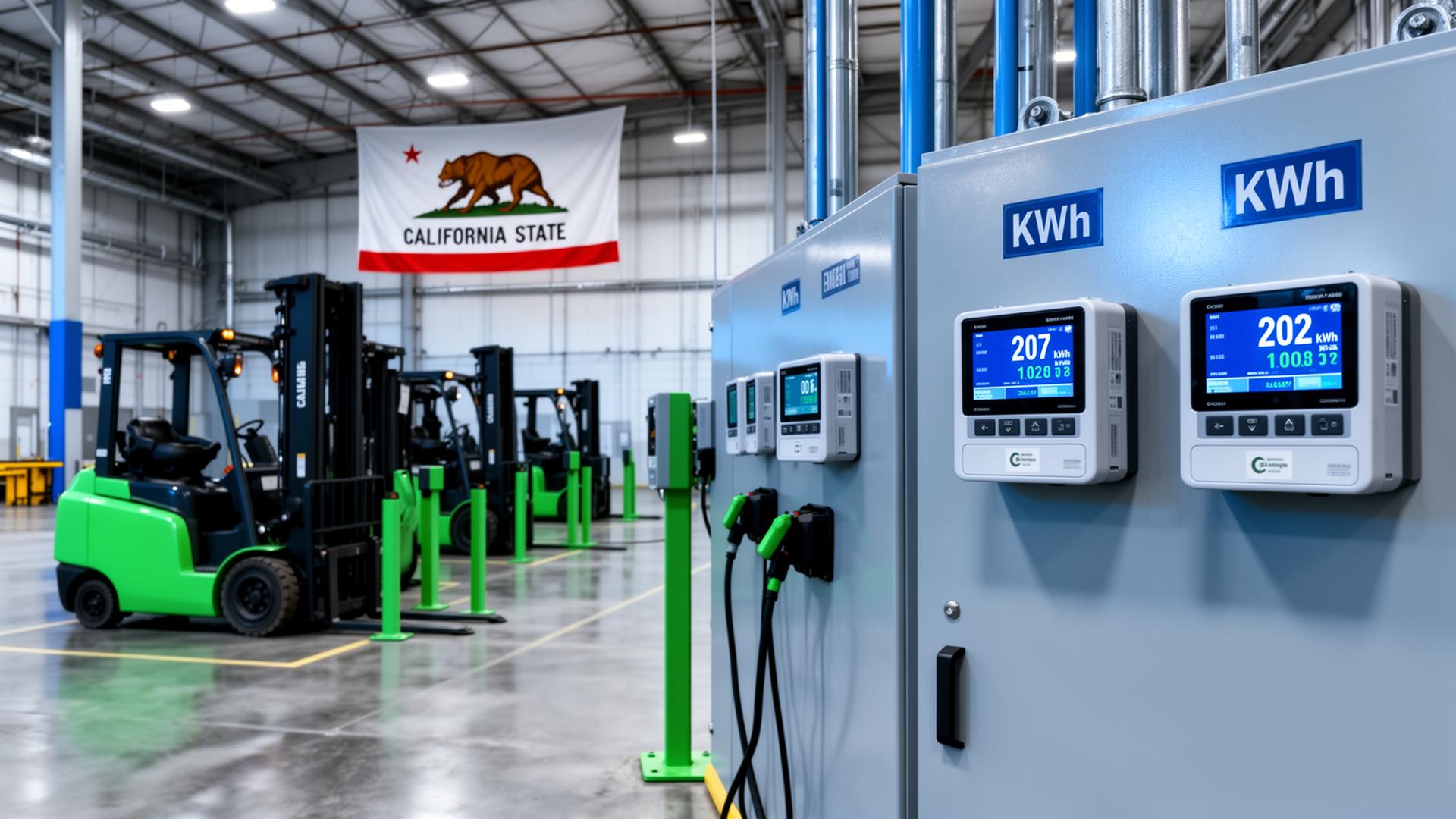
California LCFS 2026: Direct Metering for Material Handling Equipment is Now Mandatory
As of 2026, direct electricity metering is mandatory for earning Low Carbon Fuel Standard (LCFS) credits for material handling equipment. The California Air Resources Board (CARB) now requires this. This change ends the use of estimated electricity consumption for LCFS reporting.
Facilities without compliant metering will lose valuable LCFS credit revenue. Emergent Metering helps facilities meet these new rules.
What Changed in LCFS Rules?
CARB's 2024 LCFS updates (approved 2025) changed rules for electricity-as-fuel pathways. These are crucial for direct emergent metering.
Key changes for material handling equipment include:
- Mandatory direct metering: Estimation methods end January 1, 2026.
- Meter accuracy: Meters must be ± 5% accurate. They need calibration every six years (§ 95491.2(a)).
- 24-month data retention: Facilities must keep raw interval data on file. This data is for third-party verifiers.
- Third-party verification: An ARB-accredited body must verify all LCFS electricity reports.
Why Do These Changes Matter Financially?
LCFS credits for electric material handling have been highly profitable. They bring in $0.03 to $0.08 per kilowatt-hour (kWh) in revenue. This depends on market conditions.
For a large warehouse, this can mean $15,000 to $50,000+ annually. Losing this revenue due to non-compliant emergent metering is an avoidable and costly problem.
What Are the Metering Options for LCFS Compliance?
Meeting CARB's direct metering rules offers several options. Each has pros and cons for your emergent metering solution.
1. AC Panel-Level Submetering
Install revenue-grade meters at the electrical panel. These use current transformers on each circuit breaker. They feed power to forklift chargers.
- Best for: Facilities with dedicated charging subpanels.
- Advantage: Captures total energy, including charger losses. Provides the full picture CARB requires.
- Consideration: Requires a licensed electrician for installation.
2. DC-Side Charger Monitors
These simple devices install on the DC output of each forklift charger. They measure current and voltage directly.
- Best for: Fast, low-cost deployment for many chargers.
- Advantage: Most cost-effective per-charger solution.
- Consideration: Only captures DC output. It does not account for charger efficiency losses.
3. Smart Charger Telemetry
Newer lithium-ion chargers can report energy data. This happens through built-in telemetry.
- Best for: Facilities with modern equipment.
- Advantage: No extra hardware needed if equipment is compatible.
- Consideration: Restricted to newer charger and battery models. Proprietary data formats can complicate integration.
4. Circuit-Level Energy Monitoring (Recommended)
Deploy circuit-level monitoring for all charging infrastructure. Use systems like Accuenergy or Obvius. Pair them with cloud-based data aggregation.
- Best for: Facilities wanting LCFS compliance and operational insights.
- Advantage: Revenue-grade accuracy, automated data logging, 24-month retention. Offers real-time visibility into charging.
- Consideration: Slightly higher upfront cost. Provides return on investment beyond just LCFS credits.
How Emergent Metering Ensures LCFS Compliance
Emergent Metering specializes in the infrastructure CARB now demands. Our approach goes beyond minimum compliance. We provide complete emergent metering solutions.
- Revenue-grade metering hardware: We use Accuenergy, EKM, and Obvius meters. They meet or exceed CARB's ± 5% accuracy.
- Circuit-level granularity: Each charger is monitored individually. This provides granular data for verifiers.
- Automated data retention: Cloud platforms automatically keep 24+ months of interval data. This eliminates manual record-keeping.
- Verification-ready reporting: Data exports are formatted for third-party verification.
- Scalable architecture: Our systems scale for 5 chargers or 500. No re-architecture is needed.
Beyond Compliance: Operational Benefits
Facilities gain extra value from circuit-level monitoring for LCFS.
- Demand charge optimization: Adjust charging schedules. Reduce peak demand by 15–25%.
- Equipment health monitoring: Detect failing chargers early. Prevent downtime.
- Energy cost allocation: Assign electricity costs accurately.
- Sustainability reporting: Use verified energy data for ESG and carbon reports.
The Mandate for Third-Party Verification
Starting with 2026 data, CARB requires third-party verification. This applies to all LCFS electricity reports. This includes forklifts, yard hostlers, and other electric equipment.
- Tiered approach: Smaller reporters (under 10,000 credits/year) may get a limited desk review. Larger reporters face a full data audit.
- Deadline: Verification statements are due August 1 following the reporting year.
- Data quality: Verifiers check meter accuracy, calibration, data gaps, and retention.
An automated, cloud-based monitoring system simplifies verification. Manual spreadsheets will not pass an audit.
Action Steps for Facility Operators
Operating electric material handling equipment in California? Participating in LCFS? Follow these steps for your emergent metering plan.
- Inventory charging infrastructure: List every charger, capacity, and electrical feed.
- Evaluate metering options: Decide which metering type best suits your facility.
- Engage a metering partner: Work with a provider like Emergent Metering. We understand hardware and compliance.
- Install before Q1 2026: Meters must be operational early in the compliance year.
- Establish data retention: Ensure 24 months of raw interval data is archived automatically.
- Identify a verification body: Start the process with an ARB-accredited verifier.
The Bottom Line
California's LCFS is a valuable incentive program. But metering requirements are now strict. Facilities investing in compliant emergent metering will continue to earn revenue. Those that do not will miss out.
Emergent Metering can help you with this transition. We provide the right hardware, data infrastructure, and expertise before the deadline.
Ready to take the next step?
Let Emergent Energy show you what circuit-level monitoring can do for your facility.
Related Articles
Green Building United 2026 Sustainability Symposium: What to Expect After a Landmark 2025 Event
Mar 14, 2026 · 8 min read read
Energy Code Compliance Is Coming for Your Building — Are You Ready?
Mar 10, 2026 · 8 min read read
LCFS EV Charging Credits in 2026: How Metering Unlocks Maximum Credit Revenue
Mar 5, 2026 · 10 min read
About Emergent Metering Solutions
Emergent Metering Solutions provides commercial and industrial metering hardware, installation support, and energy analytics services. We specialize in electric meters, water meters, BTU meters, compressed air meters, gas meters, and steam meters with Modbus RTU, BACnet IP, pulse output, and wireless communication options. Our Managed Intelligence services deliver automated reporting, anomaly detection, tenant billing, and AI-powered consumption forecasting. We support compliance with IECC 2021, ASHRAE 90.1-2022, NYC Local Law 97, Boston BERDO 2.0, DC BEPS, California LCFS, and EU CSRD requirements.
Contact our engineering team for meter selection guidance, system design, and project quotes.